Support to Smallholder Associations Helps Meet Input Costs and Boost Profits for Women Farmers in More Remote Locations

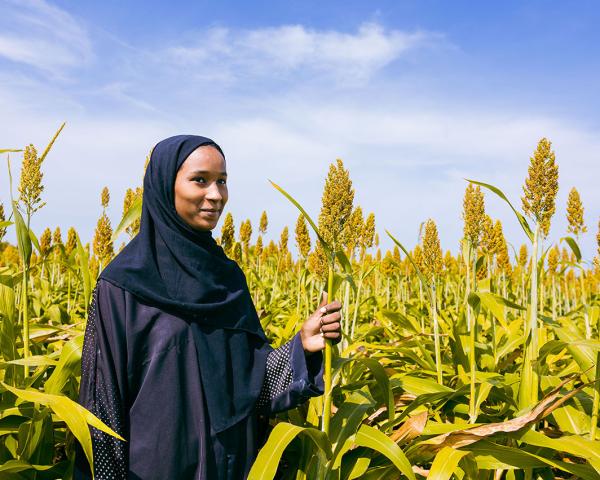
When Razaz Talib Abaker got married, she hoped to settle down in her husband’s village in Sudan’s eastern Gedaref State and teach at the local school. But even with a university degree in education, there were no teaching jobs to be found. In fact, there were no jobs at all; there was just the land, stretching round the village, the only potential source of income to support local families.
Razaz was from Kassala, the capital city of a nearby state. She’d grown up in the city and didn’t know how to farm, but she was determined to learn. So, she rented a small plot, and her neighbours helped her prepare the soil. But farming here relied on expensive inputs and her first year’s profits didn’t cover these costs.
She needed extra support – just like many other famers in the local area who were also struggling to turn a profit on small plots of land. Help was available, but there was a catch: it was only on offer to formal associations, not to individuals.
This is where Razaz’s city education finally came in handy for her new village life. She was able to understand the process of setting up an association and helped 30 of her neighbours band together into one group. They called their new association “Thiga”, meaning trust, because they knew they could rely on each other to be a new force in community development.
Eventually, Thiga was selected to be part of a UNDP project funded by Education Above All and the Qatar Fund For Development to support livelihoods and boost food security in some of the most isolated parts of Gedaref, Kassala and River Nile states. As an association, the members of Thiga receive improved seeds and training to manage their smallholdings and any business activity that helps increase profits from farming.
For Thiga, this includes a grain mill provided by UNDP’s local partner, Zeynab for Women Development. It is the village’s first mill, which means both profits for the association and also easier lives for the villagers, who don’t have to walk 5km to the next nearest mill.
“I came from Kassala, a non-agricultural community, but have learned agricultural skills and the value of collaboration within farming communities,” says Razaz. “I transformed from being discouraged and unemployed into a someone who is productive and has a renewed hope for growth and empowerment.”
Across the three states, the UNDP/EAA/QFFD project is supporting 20,000 households with seeds and training. We’re also distributing milking and breeding goats to 4,000 households, training 200 households with young people on animal care, and providing tractors to three communities.
All combined, the project’s activities demonstrate the ability of recovery efforts to make families healthier and better resourced in many parts of Sudan, even as the war continues.
Disclaimer: This story was first in June 2025 on the UNDP website. Click here to read the original post.